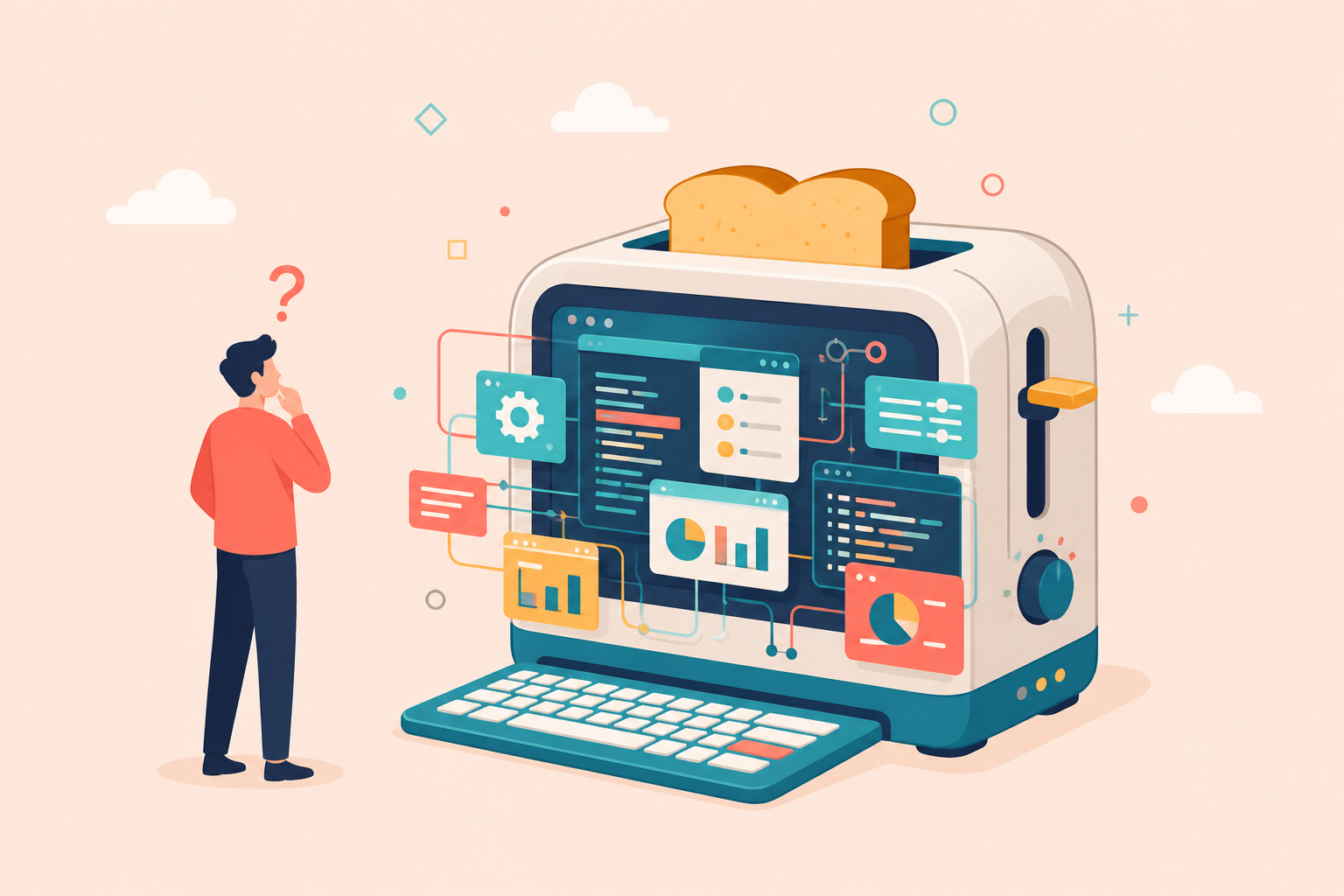

More than 25 years ago, Alan Cooper asked:
What do you get when you cross a toaster with a computer? The answer is not a smarter toaster. You get a computer with heated bread slots.
More computer than toaster.
As AI has made it almost trivial to “add software” to any product, service, or business, we're seeing more and more companies struggle with this. It seems innocuous to start. Drop a chat interface on the website. Wire up a simple dashboard. Ship a companion app because the demo looked good in a meeting. The cost and friction of the first build have collapsed, but often without understanding how technology fundamentally changes your offering, and not always for the better.
Adding a little bit of software is like being a little bit pregnant. Once technology is in the mix, whatever you were offering before stops behaving like a simple tool or service and starts behaving like software. That matters because the way people interact with software, and what they expect from it, are fundamentally different from non-digital products and services.
That shift does not stop at the product boundary. Whether you planned for it or not, it also changes the company behind the product.
You are not just a manufacturer, a retailer, or a services business that happens to have an app. As soon as software is part of how you deliver value, you are a business that operates software. That means engineering capacity, bug fixes, security patches, compatibility when platforms change, and someone who has to decide what to do when the feature nobody uses anymore stops working.
People have said that every company is a tech company for years, usually as a slogan about digital transformation. They usually take into account the cost of a one-time development effort, SaaS licenses, or cloud infrastructure bills. It's clear where those show up as line items on a budget or P&L. But all sorts of other costs, embedded in how the organization needs to change, are unaccounted for.
Most companies that start to think about custom software fixate on the build cost. They price out engineers, maybe a project manager, maybe a vendor SOW for version one. That math is visible and finite. What they do not budget for is everything adjacent to and after the build for the initial build to succeed.
A lot of dev shops will gladly bid on an RFP to build an app without pressing for all those details. What they won't tell you until the change orders start rolling in is that building software needs inputs (product direction, detailed requirements, design) that you may not have planned for.
Proper product work takes time: figuring out what to build, chasing down detailed requirements, deciding what to defer, and how to sequence work so you are not shipping features nobody asked for or missing dependencies that are table stakes for the product to function. UX and design work takes expertise: research, flows, interaction patterns, copy, accessibility, and the unglamorous iteration required to make something understandable to people who were not in the room when it was conceived. QA takes discipline: test plans, regression coverage, and the willingness to delay a launch when the happy path works but the edge cases do not.
If you got a bid to "build" your app, did it include all of that? If not, are you prepared to do it yourself?
Then there is the long tail. Bug fixing is not a one-time cleanup sprint. It is a permanent tax on every team that ships code. Maintenance is not optional: dependencies age, browsers update, APIs change, and the workaround someone wrote in a hurry becomes load-bearing infrastructure. And none of this happens in a vacuum. You are delivering features over time against an internal roadmap that keeps shifting and a competitive landscape that does not pause while you catch up. Customers use your product in ways you hadn't imagined or intended and start asking for changes and new features. Even if you decide not to do those things, someone has to field all the requests and decide what to do.
Mature tech companies know this. They staff for it, however imperfectly. They have product managers, designers, QA engineers, and enough engineering capacity reserved for fixes and upgrades, not just greenfield features.
But when an existing business becomes a software operator overnight, they often try to run a permanent product business on a project budget. The first release ships. The team disperses. Six months later the app needs an update, users are confused, bugs pile up, and leadership wonders why because "we already paid for the software."
Another trap is treating technology as something to hand off entirely to an IT team and then walk away from. But, software is not a factory output you order to spec and receive on a loading dock. It encodes decisions about how the business works, what customers experience, and what tradeoffs you are willing to make. Those decisions need strategic thought and alignment with the business, not just technical execution.
Someone with real insight into the business, and real influence inside it, has to be involved and empowered to make product decisions. Not consulted after the fact. Not cc'd on status updates. In the room, with authority. It might be a product leader, a domain expert who learns to think in product terms, or a business executive who takes ownership of the digital experience. The title matters less than the combination of knowledge and authority: they understand how the company makes money and serves customers, and they can say no to a feature that is technically easy but strategically wrong. And vice versa — they can insist on a feature that the tech team wants to defer but which is table stakes for the success of the business.
When that person is missing, or present but powerless, you get the worst of both worlds: all the ongoing cost of operating software, with none of the strategic benefit. Engineering builds what's easiest to do (or whatever they want). Vendors build what is in the SOW, nothing more and nothing less. AI builds what someone prompted on a Tuesday. Nobody owns whether any of it actually moves the business forward.
Software is not a "build it once and move on" proposition. All software requires maintenance and upkeep. Always. The slice you ship today becomes tomorrow's obligation. Being a tech company means you inherit both the upside and the operating model, whether or not you planned for it.
AI is making it cheaper to build software and it can help with some of the ongoing work, but it doesn't change the obligations your business incurs by becoming a tech company. People still have to stay on top of it.
There is a quieter version of the same trap happening inside companies, not just in customer-facing products.
For a lot of companies, for a long time, a set of magical spreadsheets keep the company running. It's messy, but it's always been possible to pull back the curtains and make sense out of the spiderweb of references and custom formulas to understand what those spreadsheets are doing.
Now teams are using AI to automate internal processes: create custom dashboards, workflow tools, data pipelines stitched together in an afternoon, "temporary" scripts that become the way a department actually runs. At the start it looks like massive efficiency. From the inside it works like a secret virus that turns you into a technology company without anyone signing up for that explicitly.
The first build feels free. Someone with domain knowledge and a few prompts produces something that solves today's problem. It works on their machine, for their workflow, with their mental model of how the data fits together.
Then someone else in the org wants access to the tool. The person who built it goes on vacation. The API it depends on changes. Leadership asks for a report from it and discovers nobody can explain how the numbers are calculated.
Once you build something, someone needs to understand it, maintain it, and operate it. That someone might be the person who vibe-coded it on a Tuesday, and it becomes an unfunded IT burden nobody owns. However it locally it started, the organization now has software debt. The company did not decide to become a tech company, it happened one useful internal tool at a time.
This is where I spend a lot of my time as a designer, and it is the gap I see most often when AI enters the picture.
It is relatively easy to create something you understand and can use for yourself. You know where the edge cases are because you live inside the process. You know which fields matter because you added them yourself. You know what "success" looks like because you are the user.
Building something for other people to understand and use is something altogether different, and most people struggle to do it. Other people do not share your context. They need labels that make sense without a verbal walkthrough. They need error messages that tell them what to do next, not what went wrong in your stack trace. They need flows that match how they think about the task, not how the data happens to be structured in your database. They need to trust the output without calling you every time a number looks off. And they don't have patience for your idiosyncrasies.
Next-level complexity? Designing and building shared tools and interfaces. Shared interfaces force you to articulate assumptions you did not know you were making. That work is slow, iterative, and deeply unglamorous. AI does not remove it. If anything, AI makes it easier to gloss over it, because the prototype looks finished before you have done the thinking required for someone else to use it safely.
This is the asymmetry teams often underestimate. AI accelerates your ability to solve problems with technology. It does not necessarily accelerate your ability to clearly articulate the problems and the appropriate solutions.
Generating a UI is fast. Deciding what the UI should do, for whom, under what constraints, with what tradeoffs, is not. An AI model will happily build the wrong thing at impressive speed. It will also happily build the right thing for a problem you have not actually defined yet, which is often worse because it creates the illusion of progress and the burden of managing that thing it built.
Good product work still requires questions that AI does not answer on its own:
Those questions are not blockers to moving fast. They are what keeps fast movement from becoming expensive rework.
If you are a small services business, this probably sounds expensive. The truth is that it can be. You did not get into your line of work planning to hire a whole product team in perpetuity just to streamline internal operations or test a digital idea.
That is a fair reaction. It does not mean you should avoid software entirely. It means you should be deliberate about how and when you commit.
Before you make a company-transforming leap, ask whether the thing you want to build is simple enough that someone on your existing team could own it long term, as part of their current role. A focused internal tool. A workflow improvement for one department. Something with a narrow scope and a clear owner who understands the business and will still be there in a year. That can be a smart experiment: real enough to learn from, small enough that you are not reorganizing the company around it on day one.
Just don't let the power of rapid prototyping with AI fool you. You are not going to build "Uber for ____" in three months with a temporary team and a tight budget because you were able to build a demo app with AI in an afternoon. Marketplaces, multi-sided platforms, and anything that needs to scale across customers, operations, and compliance is a software business, full stop. AI does not compress that into a quarter. It just gets you to a convincing prototype faster, which can make the eventual gap between demo and reality even more painful.
There is a middle path that works well for a lot of companies that are not ready to hire a full-time, growing internal team yet. Start with a scoped build. Ship something real. Pause. See how people use it, what breaks, and whether the business case holds before you fund the next phase. Repeat.
That rhythm is hard to pull off with a one-and-done vendor SOW or a hire-you-fire-you project team. It is much easier with a partner who can scale up when you need design, product, and engineering muscle, and scale down when you need time to learn. That is often the right model early on: enough capability to get something off the ground, without pretending you have become a fully staffed software company overnight. It is also how we tend to work with clients at Uptech Studio when they are proving out whether a product idea deserves a bigger commitment.
None of that removes the obligations described in the earlier part of this post. It just lets you take them on in stages, with eyes open, instead of all at once because the first build felt cheap.
When you contemplate adding software to something that worked fine without it, understand what you are signing up for. Not just the build, but the product and company you become.
Customer-facing or internal, the pattern is the same: software changes expectations, creates ongoing obligations, and demands people who can maintain shared systems other humans depend on.
If you're just starting to think about how to weave technology into your business, or you've already jumped in head first and realize you need some outside help, we're ready to dig in with you. Whether that's strategy, guidance, and advice or hands on product design and development, we love to help companies integrate technology into their businesses in a way that's sustainable and successful.

