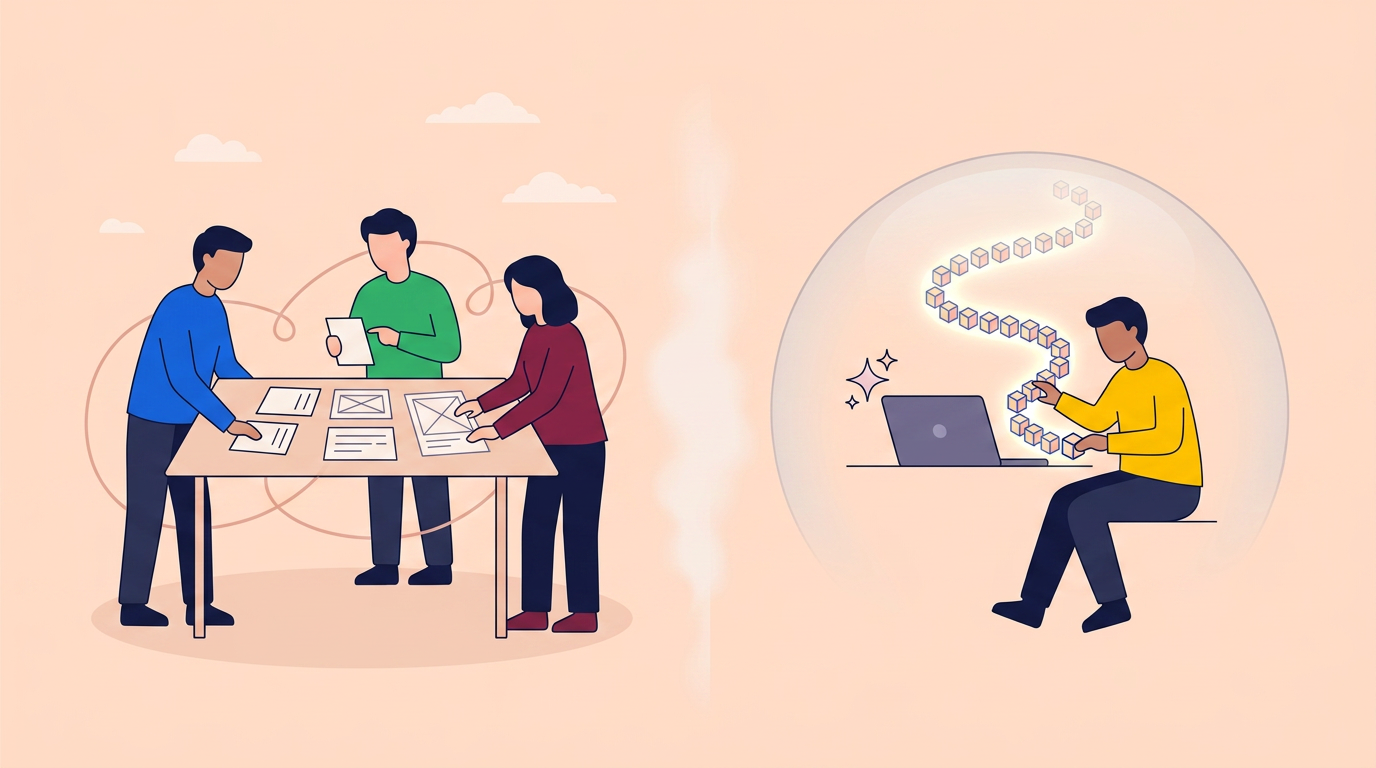

Recently I have been thinking about what the vibe coding process is quietly breaking, and it is not always just quality. It is also shared context, for humans, not AI.
Software development at its core has always been about translating an idea into something real that people can use. For a long time, that process looked something like this:
Once this loop was in a good place, only then did you kick off development. Sure, the upfront took time, but the result is that a lot of the painful lessons landed in more than one head.
Now a single motivated person with AI as copilot can chase an idea from a prompt to a working demo without inviting anyone else into the messy middle. In fact, inviting others just slows things down.
While that feels empowering to non-technical people, it is also a great way to end up with something only the author understands. They are the only ones who know every shortcut, every ignored error, every "just for now" call. Everybody else opens the project and quietly backs away.
If the goal is a sustainable product that can scale past the person who started it, teams need a deliberate way to transfer knowledge between people. Real specs that live in a planning folder in the repo, a PR process where commits explain the why and not just the what, or frequent walkthroughs of code changes that might feel boring to some. Pick the mechanics that fit the team, but something has to happen.
At Uptech Studio, we meet a lot of teams who moved fast, built something real, and now need help extending it. There is sometimes an expectation that we can magically understand the whole thing immediately from the codebase. We still need the context. We need to learn what you learned while you were building alone. Often it is more beneficial for us to hear about the struggle than to stare at code without story. Track those learnings somewhere durable.

